Quick answer
Check your HVAC filter every month and change it when it looks dirty, or at least every 3 months. MERV ratings show how well a filter traps particles; higher is better at trapping. If you upgrade, EPA suggests at least MERV 13, or as high as your system can handle. Ask a technician what yours can take.
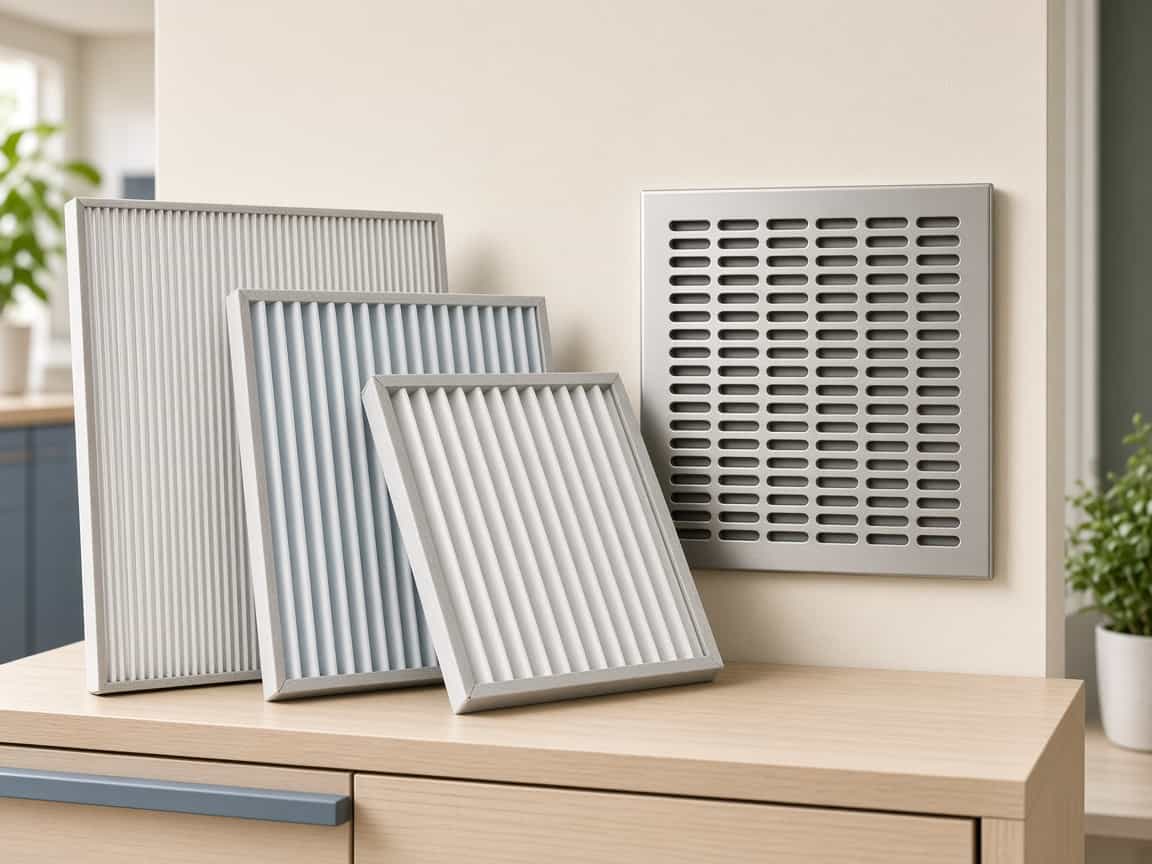
Key facts
| Check the filter | Every month (ENERGY STAR) |
|---|---|
| Change it | When dirty, at least every 3 months |
| What MERV measures | Capture of particles 0.3–10 microns (EPA) |
| If you upgrade | MERV 13+, or as high as your system allows |
| Airflow arrow | Points toward the furnace or air handler |
| Ductless filters | Clean when dirty or the filter light is on |
Where is the air filter in my HVAC system?
Your filter is usually in one of two places: behind a return air grille on a wall or ceiling, or in a slot at the furnace or air handler. Some homes have filters in both places, so check before you buy.
Ductless mini-splits are different. Their filters are washable screens behind the front cover of each indoor head. ENERGY STAR says to clean them when they look dirty or when the filter light comes on.
Common filter spots in ducted systems:
- Return grille: a large vent, often in a hallway or ceiling, with clips or latches.
- Furnace slot: a narrow cover or door on the side or bottom of the furnace, near where the big return duct connects.
- Air handler: a filter door on the indoor cabinet, often in a closet or garage.
Filter doors and grilles open by hand. If reaching the filter means removing screws or opening a panel with wiring behind it, stop and ask a technician to show you where it goes.
How often should I change my furnace filter?
Check your filter every month, and change it when it looks dirty — at least every 3 months, according to ENERGY STAR. Check it more often in heavy-use months, like winter and summer.
Filters also come with their own replacement advice. EPA says all filters need periodic replacement to work properly, and to follow the maker's recommendations. An easy habit: check the filter at a set time each month, such as when you pay a regular bill, and write the date on the new filter's frame when you put it in.
Check more often when a filter is likely to load up faster:
- You have pets that shed.
- You're remodeling, sanding, or doing other dusty work.
- It's wildfire smoke season.
- Your system is running a lot during a cold snap or a heat wave.
Not sure what's wrong yet?
Start with the safe checks. Many problems are a setting, a breaker, or a filter.
- Repair first: we fix what can be fixed
- You approve the price before work starts
- Sources listed for outside facts
How do I check and change an HVAC filter?
In most homes, changing a filter takes a few minutes and no tools. Here's how:
- 1Turn the system off at the thermostat.
- 2Open the grille or filter door and slide the old filter out. Note which way the arrow on its edge points.
- 3Hold it up to a light. If little light gets through, or it's gray and dusty, it's time for a new one.
- 4Read the size printed on the edge of the frame: width, height, and thickness.
- 5Slide in the new filter with the airflow arrow pointing toward the furnace or air handler — away from the room.
- 6Make sure it fits snugly with no gaps around the edges. Don't bend or crush it to make it fit.
- 7Close the door or grille and turn the system back on.
What size air filter do I need?
The size you need is printed on the edge of your current filter. It's listed as three numbers: width, height, and thickness. Buy that exact size.
If there's no old filter, or the label has worn off, measure the slot or grille opening and ask a technician before you guess. A filter that's too small lets air — and dust — slip around it. A filter that's too big can get bent or crushed, which EPA says to avoid.
Some systems take thicker filters than others. A thicker filter only works if the filter slot or cabinet was built for it. Once you know your size, write it down or snap a photo, and keep a spare on hand so you're not stuck with a dirty filter during a cold snap or smoke season.
Why does a dirty filter cause problems?
A dirty filter slows airflow, so your system works harder to heat or cool your home. ENERGY STAR says that wastes energy and lets dust build up inside the system, which can lead to expensive maintenance or early failure. It also notes that airflow problems can cut a system's efficiency by up to 15 percent.
A clogged filter is one common cause of problems that sound bigger than they are:
- A furnace that shuts off early or cycles on and off because it's running too hot.
- An AC or heat pump with ice on the indoor coil or the refrigerant lines.
- Weak airflow at the vents, and rooms that won't warm up or cool down.
- Higher energy bills with no other change.
What does a MERV rating mean?
A MERV rating tells you how well a filter traps small particles. EPA explains that MERV — Minimum Efficiency Reporting Value — measures a filter's ability to capture particles between 0.3 and 10 microns. The higher the MERV, the better the filter traps particles of those sizes.
Here's what EPA's table shows for a few common ratings:
| MERV rating | Average capture, per EPA |
|---|---|
| 1–4 | Less than 20% of particles 3.0–10.0 microns |
| 8 | At least 20% of 1.0–3.0 microns; at least 70% of 3.0–10.0 microns |
| 11 | At least 20% of 0.3–1.0 microns; at least 65% of 1.0–3.0 microns; at least 85% of 3.0–10.0 microns |
| 13 | At least 50% of 0.3–1.0 microns; at least 85% of 1.0–3.0 microns; at least 90% of 3.0–10.0 microns |
| 16 | At least 95% in all three size ranges |
Should I use a higher MERV filter?
A higher-MERV filter can trap more fine particles, but only if your system can move enough air through it. EPA suggests that if you upgrade, you choose at least MERV 13, or as high a rating as your system fan and filter slot can accommodate. EPA adds that you may need an HVAC technician to find the highest-efficiency filter that works for your system.
Some higher-MERV filters are denser, and not every system is set up for that. If you're not sure, ask a technician whether your system can handle a higher-MERV filter before you switch. A technician can look at your filter slot, your fan, and how air moves through your system.
EPA also notes that filters help but can't remove all pollutants. It says the most effective steps are cutting pollution at the source and bringing in clean outdoor air.
Common questions
Which way does the arrow on an air filter go?
The arrow should point toward the furnace or air handler, in the direction the air flows. That means it points away from the return grille and the room. If you're unsure, note the direction of the old filter before you pull it out.
Is MERV 13 too high for my furnace?
It depends on your system. EPA says to choose at least MERV 13 if you upgrade, or as high as your fan and filter slot can accommodate, and that a technician may need to help decide. If you're unsure, ask a technician before switching.
Can a dirty filter make my furnace shut off?
Yes, it can. A clogged filter restricts airflow, and many furnaces shut down to protect themselves when they run too hot. Change the filter first. If the furnace still won't run right, call a technician.
Do ductless mini-splits have filters?
Yes. Each indoor head has washable filters behind its front cover. ENERGY STAR says to clean them when they look dirty or when the filter light comes on.
Is a HEPA filter the same as a high-MERV filter?
No. HEPA filters are a type of pleated filter common in portable air cleaners, and EPA notes their ratings aren't based on the MERV system. Central heating and cooling systems usually use MERV-rated filters.
Does a clean filter lower my energy use?
A clean filter helps your system avoid wasting energy. ENERGY STAR says a dirty filter slows airflow and makes the system work harder. How much it changes your bill depends on your system and how dirty the old filter was.
Not sure what's wrong yet?
Start with the safe checks. Many problems are a setting, a breaker, or a filter.
- Repair first: we fix what can be fixed
- You approve the price before work starts
- Sources listed for outside facts
Sources
- What is a MERV rating? — U.S. EPA. Checked 2026-09-24.
- Air Cleaners and Air Filters in the Home — U.S. EPA. Checked 2026-09-24.
- Heat & Cool Efficiently — ENERGY STAR (U.S. EPA). Checked 2026-09-24.
- Maintenance Checklist — ENERGY STAR (U.S. EPA). Checked 2026-09-24.
- Air-Source Heat Pumps — ENERGY STAR (U.S. EPA). Checked 2026-09-24.
Last updated: · Reviewed by: HVAC Repair Guys